
Prince of Persia story
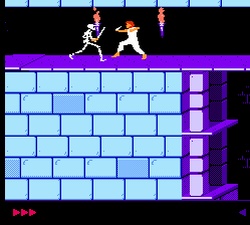
The story of Prince of Persia began with the dream of one man — Jordan Mechner. A young developer fascinated by cinema, Eastern tales, and acrobatics, he blended all these interests into a single vision. He wanted the game’s character to move not like a drawn puppet, but like a real human. To achieve this, Mechner used rotoscoping — a technique where live-action footage is traced frame by frame. His brother acted as the stuntman, jumping and falling to become the hero’s movements, while Jordan spent hours translating each motion into pixels. This process created the flexible, vulnerable prince whose movements feel believable from the very first step through the castle’s shadowy corridors.
The Birth of a Legend
In the late ’80s, the market was flooded with shooters and arcade games, but the “Prince” game stood out immediately. It didn’t give players a sense of omnipotence — every action required caution. The plot was simple yet compelling: an evil vizier seizes power, the princess is captive, and there’s only an hour to save her. This compressed drama gave the game a unique rhythm. Players worldwide recall holding their breath while watching the sand timer and feeling relief when they cleared another trap. The game launched first on computers but quickly moved to consoles, including the NES, reaching a whole new audience.
Why It Captivated Players
Prince of Persia is free of excess. Every element contributes to the atmosphere: empty corridors feel threatening, guards’ swords whistle past your face, and the hero’s footsteps sound as if you are walking on stone yourself. This honesty and simplicity made the game special. Players appreciated it not for complex mechanics but for its emotional impact. There were no punishing scores or intrusive rewards — only the pure feeling of danger and the drive to succeed. This approach was rare and helped the game stand out among dozens of other adventures of the era.
Spread and Influence
As Prince of Persia reached different countries, it became a cultural phenomenon. In some households, families gathered around the console, taking turns to beat a level; in others, children competed to see who could jump over a trap first. In Russia, the game achieved cult status: it was discussed in schoolyards, and nearly everyone knew someone familiar with its “secret” tricks. On the NES, Prince of Persia found a second life, as the console edition introduced many players to the story for the first time. The mix of Eastern fairy-tale atmosphere, time pressure, and intense gameplay cemented its place as a symbol of a generation.
Legacy
Today, Prince of Persia is remembered as a classic, but it was a bold and alive project for its time. It was an experiment that proved hugely successful, showing that games are not only about levels and points, but also about emotion, a sense of danger, and the experience of the moment. That is why many still return to this story — to hear the clash of swords, feel the tremble of floorboards underfoot, and test their courage to reach the end. And therein lies the game’s core story: the tale of a prince that has long become a shared memory for players everywhere.